EASY
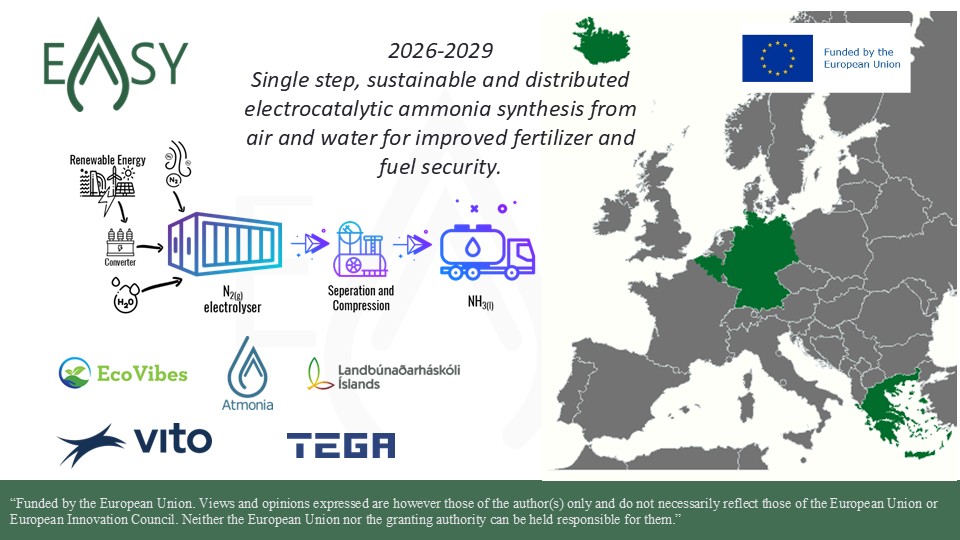
The EASY project is revolutionising ammonia production by advancing the Atmonia process from lab concept to practical application. Unlike the traditional, carbon-heavy Haber-Bosch method, EASY uses a sustainable approach to create ammonia from air and water, effectively harnessing renewable energy without the need for high pressure or temperature. This new method sets a standard for safe and decentralised ammonia production, tailored for intermittent energy sources. By the project’s end, EASY aims to deliver an operating prototype ready for scaleup and demonstrated on farm, a market confirmed business-plan and a clear permit pathway for fertilizer and e-Fuel.

Consortium Members
Atmonia
Atmonia (Iceland) was founded in 2016, focusing on catalyst development for electrochemical synthesis of ammonia at ambient conditions using aqueous electrolytes. They have developed a methodology beyond the state of the art for in situ analysis of electrochemical NRR.
VITO
The Electrochemistry Excellence Centre within the VITO – Vlaamse Instelling voor Technologisch Onderzoek N.V. (Belgium) has extensive experience in design of electrochemical cells and electrodes, and electrochemical process development. The Flemish research institute has a significant focus on sustainable electrochemical processes, with the goal to support and enhance European innovation base towards a sustainable future.
EcoVibes
EcoVibes (Greece) is a sustainability consulting firm specialising in Life Cycle Assessment (LCA) and environmental, economic, and regulatory analysis. ISO 9001 and ISO 14001 certified, EcoVibes brings both technical rigour and strategic insight to evaluate the integrated sustainability performance and regulatory pathway of the EASY process, supporting decision-making throughout the development of this novel production method.
LBHÍ
Agricultural University of Iceland plays a key role in developing societal issues related to agriculture, natural resource use, planning, environment and climate, and contributes to the EASY project as an end-user demonstration partner by testing prototype equipment and evaluating its output from a practical agricultural perspective.
TEGA
TEGA – Technische Gase und Gasetechnik GmbH (Germany) is a leading company in supply and services related to technical gases. Their capabilities in developing a system for separating and liquifying NH3 from the process outlet are undisputed.